
StreptaClick® Precision
for Assay Development
StreptaClick® Precision — Monovalently Binding Streptavidin for Click Chemistry
Customize StreptaClick® to match your precise assay or product requirements. Our novel StreptaClick® Precision molecule, specifically designed for Copper(I)-catalyzed azide-alkyne cycloaddition (CuAAC) or copper-free Strain-promoted azide-alkyne cycloaddition (SPAAC) click chemistry has exactly one azide or DBCO reactive site. This enables the precise attachment of exactly one molecule of choice to each StreptaClick® Precision molecule, catering to applications requiring a stoichiometrically precise 1:1 ratio of reporter to binder. Furthermore, StreptaClick® Precision maintains its remarkable biotin-binding capability and effortlessly connects to any biotinylated antibody or protein in solution without causing aggregation via its two clustered biotin binding sites in cis-position. The dual binding sites ensure biotin binding is not blocked by bulky molecules such as oligonucleotides.
Possible applications include:
- DNA origami, precise labeling of reaction surfaces or beads
- Super-resolution microscopy
- Antibody-oligonucleotide conjugate based immunoassays such as immuno-PCR, immuno-RCA, and Proximity Ligation Assays
- Prototyping or screening antibody-drug conjugates, label free antibody-antigen interaction kinetics for antibody therapeutics
- Screening targeting antibodies conjugated to delivery systems such as lipid nanoparticles or extracelluar vesicles in the development of advanced therapies and medicinal products (ATMPs).
- Antigen-labeling to measure receptor/ligand or antigen/antibody interactions.
Should you require a greater ratio of reporters per binder we are currently developing StreptaClick® Precision versions with exactly three or seven reactive groups. If you wish to explore novel applications using StreptaClick®, please do not hesitate to contact us.
StreptaClick® Precision - a cis-divalent streptavidin primed for Click Chemistry and multiplexing

StreptaClick® Precision differs from our previous monovalent StreptaClick® Color and StreptaClick® HRP molecules in that it has been redesigned with dual biotin binding sites clustered in cis-position, making it cis-divalent. Nonetheless, this design still exhibits monovalent binding properties to antibodies while conserving its native binding affinity to biotin, ensuring unmatched specificity in molecular interactions. In early experiments we observed that monovalent StreptaClick® could have its biotin binding obscured by bulky molecules such as oligonucleotides, a problem that has now been solved with StreptaClick® Precision. Furthermore, the cis position of the two biotin binding sites still negates antibody aggregation and allows mixing in solution just as our other monovalent StreptaClick® products. This makes StreptaClick® Precision ideal for multiplexing.
How it works
Easily attach the azide labeled StreptaClick® Precision molecule to your reporter molecule of choice via click chemistry. The choice of azide or DBCO functionalization enables either Copper(I)-catalyzed azide-alkyne cycloaddition (CuAAC) or copper-free Strain-promoted azide-alkyne cycloaddition (SPAAC) click chemistry, ensuring accurate and specific labeling in many different types of experiments.
StreptaClick® Precision Workflow

Achieve high conjugation efficiency
Conjugating reporters to StreptaClick® Precision via CuAAC or SPAAC click chemistry typically results in 90-100% labeling efficiency with only 1.3X excess of reporter to StreptaClick® molecules.

Native gel comparing StreptaClick® conjugated to oligonucleotides to controls
- StreptaClick® Precision – Oligo (off-the shelf kit, 14 bp)
- Control: StreptaClick® Precision – DBCO
- StreptaClick® Precision – DBCO + 43 bp oligo – azide
- StreptaClick® Precision – DBCO + 41 bp oligo – azide
- StreptaClick® Precision – DBCO + 37 bp oligo – azide
- Control: StreptaClick® Precision – Azide
- StreptaClick® Precision – Azide + 20 bp oligo – DBCO
- StreptaClick® Precision – Azide + 20 bp oligo – DBCO
Attach StreptaClick® Precision conjugate to any biotinylated antibody or surface
After the click chemistry reaction, add the newly formed StreptaClick® Precision construct to your biotinylated protein or surface of interest for near immediate conjugation. We also have a convenient biotinylation kit available for purchase, BiotinPureTM, if you lack access to biotinylated antibodies.

This innovation grants you full control over labeling position and ratio, enabling detailed exploration of protein behaviors, interactions, and localization.
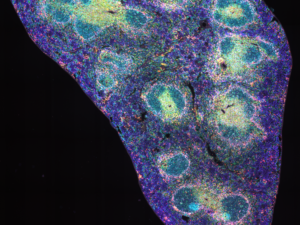
The image below shows an example of a fresh frozen mouse spleen tissue in which StreptaClick® Precision – 1 Oligo bound to an anti B220 biotinylated antibody from Biolegend interacts with B220 proteins on B-lymphocytes. The interaction is visualized via immunofluorescence imaging by hybridization of an antisense oligo with a 647nm fluorochrome to StreptaClick® Precision – 1 Oligo. Other possible readouts for antibody-oligonucleotide conjugate based methods include q-PCR and DNA sequencing.

The perfect starting point for assay development
StreptaClick Precision has greatly facilitated our research based on lipid nanoparticles (LNP).
We study subsets of macrophages using antibody coated LNPs containing functional RNA to
genetically reprogram the subsets through antibody-targeted delivery. We can now simply
generate a large batch of StreptaClick Precision LNPs via click chemistry and then easily mix
this with different biotinylated antibodies from our library to screen for the most suitable
antibodies to use for the targeting.
We have recently evaluated a new version of StreptaClick Precision that features, in
addition to azide for click chemistry, a tracer fluorochrome. This allows us to confirm LNP
uptake by the correct subset as well as correlate this to the expression of target RNA by GFP
or mCherry in another fluorescent channel.
StreptaClick Precision has become a game changer for us as it is convenient, consistent
and flexible compared to directly conjugating each antibody to the LNPs, and also cost
effective.
Anders Etzerodt, Associate Professor, PhD
Department of Biomedicine
Aarhus University, Denmark

BiotinPure™ Antibody Biotinylation Kit
The BiotinPure™ Antibody Biotinylation Kit is a complete kit for easy biotinylation of antibodies at room temperature within 1 hour. The kit uses amine/ester chemistry to attach 2-3 biotins per antibody and includes a purification wash step that removes unreacted free biotin from the final biotinylated antibody solution.
The antibodies to be biotinylated should be free from other proteins, such as BSA.
The BiotinPure™ Antibody Biotinylation Kit is designed for use with StreptaClick® reagents. The biotinylated antibodies may also be used for other applications.
Cat. no. 9000051-1
Order or request further information
Select your BiotinPure™ Kit:

SpectraSplit® 10 (filter sets for 10 color channels)
SpectraSplit® 10 (filter sets for 10 color channels) , developed from our patented SpectraSplit® 7 filter sets, will revolutionize fluorescence microscopy as 10 channels can be directly imaged without spectral unmixing. The channels are distributed over five filter sets and separate the most commonly used fluorochromes in immunofluorescence, in addition to channels anticipated to gain popularity in the near future (see table below). Tissues and other sample types can be immunostained with up to 10 fluorochromes, visualized without bleedthrough. No additional software and no computational spectral unmixing are required.
SpectraSplit® 10 (filter sets for 10 color channels) can easily be installed in both standard and scanning fluorescence microscopes.
Catalog no. 7101991-1 SpectraSplit® 10 (filter sets for 10 color channels)
Request a quote or information


SpectraSplit® 7 (filter sets for 7 color channels)
SpectraSplit® 7 (filter sets for 7 color channels) are patented filter sets that empower fluorescence microscopes with seven color channels. The channels are distributed over four filter sets and specifically separate the most commonly used fluorochromes in immunofluorescence. Hence, you can immunostain tissues with up to seven fluorochromes and still visualize each fluorochrome in the sample with SpectraSplit® 7 without bleedthrough. No additional software and no computational spectral unmixing are required.
SpectraSplit® 7 can easily be installed in both standard and scanning fluorescence microscopes, and can be run with different popular light sources.
Cat no. 7001991-1 SpectraSplit® 7 (filter sets for 7 color channels)

StreptaClick® 8-plex for ZEISS Axioscan 7 spatial biology
The StreptaClick® 8-Plex Multiplex IHC Kit provides a rapid and heat-treatment-free Tyramide Signal Amplification (TSA) staining cyclic workflow for frozen and FFPE tissue sections. It is optimized for imaging on the ZEISS Axioscan 7 spatial biology platform, enabling visualization of up to eight colors in a single run. The kit is ideal for researchers in high-throughput laboratories who require a reliable, time-efficient, and flexible multiplex immunohistochemistry workflow.


StreptaClick® Color
StreptaClick® Color is a modified streptavidin that labels biotinylated antibodies with fluorochromes in solution, mimicking directly conjugated antibodies as we have removed the issue of antibody aggregation through monovalent binding. StreptaClick® Color provides a rapid, robust, and flexible method for attaching fluorochromes to biotinylated antibodies. Once labeled with StreptaClick®, the antibody is stable and can be used in the same manner as antibodies that are directly conjugated with fluorochromes. The labeling reaction is highly efficient and can be carried out at any volume, concentration, or buffer.
Order or request further information
Select your StreptaClick® Color Kit:


StreptaClick® HRP (heat-free multiplex TSA based IHC)
StreptaClick® HRP Multiplex IHC Kit is an accelerated heat-treatment-free multiplex Tyramide Signal Amplification (TSA) staining solution for up to nine markers (8 antibodies + DAPI). It is suitable for fixed cells, FFPE samples and frozen, OCT embedded tissues. This comprehensive kit is designed for researchers who demand ease of use and flexibility in multiplex immunohistochemistry (IHC).
The kit includes everything needed to label biotinylated primary antibodies with horseradish peroxidase (HRP) enzyme in solution utilizing our modified streptavidin StreptaClick®. As StreptaClick® removes the issue of antibody aggregation through monovalent biotin binding it is particularly suited for labeling primary biotinylated antibodies. The kit also features a novel HRP Quench Buffer that eliminates the need for antibody-stripping by heat-treatment such as boiling between cycles. This feature maintains tissue morphology over multiple staining cycles making it ideal for both frozen and FFPE tissue sections, and higher degrees of multiplexing than comparable solutions.
In combination, these features makes the protocol highly automation-friendly, while results for manual staining of six markers + DAPI are achievable in one day.
Order or request further information
Select your StreptaClick® HRP Kit:


StreptaClick® Precision
StreptaClick® Precision is a modified streptavidin designed for precise stoichiometric 1:1 conjugations. Currently, StreptaClick® Precision is available with exactly one azide or exactly one DBCO (dibenzylcyclooctyne). StreptaClick® Precision also features a unique cis-divalent design for enhanced monovalent binding to biotinylated proteins. In addition, the conjugation site and the biotin binding region are on opposite sides of StreptaClick® Precision, minimizing the risk of conjugates interfering with biotin binding. This design makes StreptaClick® Precision ideal for attaching bulky molecules without sterically hindering biotin binding and without causing aggregation when mixed with biotinylated antibodies in solution.
Click-chemistry ready
StreptaClick® Precision is currently available with a single azide or DBCO group for either copper(I)-catalyzed azide-alkyne cycloaddition (CuAAC) or copper-free strain-promoted azide-alkyne cycloaddition (SPAAC) click chemistry.
For oligonucleotides, we strongly recommend SPAAC click chemistry (DBCO/azide).
Pre-conjugated, off-the-shelf
StreptaClick® Precision based, pre-conjugated products are also available. These include StreptaClick® Precision with a single 14 mer DNA oligonucleotide or a single bright fluorochrome (488 nm or 647 nm).
Custom conjugation as a service
Please inquire to discuss the feasability of your project.
Order or request further information
Select your StreptaClick® Precision Kit:
